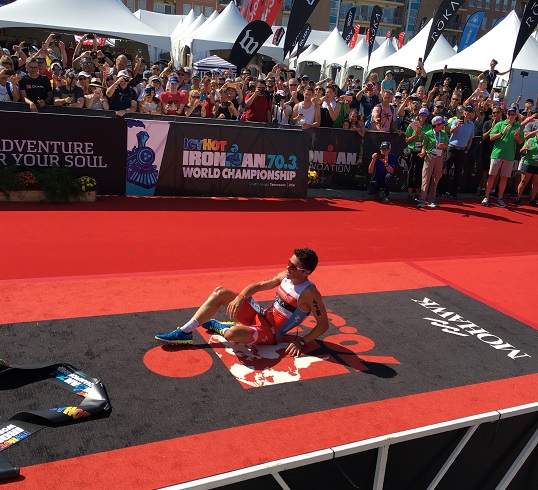
I toed the start line for the Ironman 70.3 World Championships in Chattanooga. It did not go well. The honest story of a year fighting open-water panic — and the people who carried me through it.
Last Sunday, September 10th, 2017, I toed the start line for the Ironman 70.3 World Championships in Chattanooga. It did not go well — and to properly tell that story, I need to start a year earlier.
After crashing last April and stopping the fall with my face, I missed six weeks of training. I missed it, badly. Before that I'd been training consistently but without drive — I was missing the fire, the spark that lights up when the 5 a.m. alarm goes off and it's still pitch black. Absence makes the heart grow fonder: six weeks of doing nothing (no reading, TV, phone, or laptop) relit that fire in a big way. The moment my neurologist cleared me, I dove back in with a focus I hadn't had since training for my first NYC Marathon in 2011. That fall I built through Eagleman, Challenge Roth, and Ironman Arizona, and carried real momentum into 2017.
So I hit 2017 hard. The story of this race is really the story of my swim that year — and how it came apart.
Puerto Rico. I came in fitter than I'd ever felt, swimming 10,000–12,000y/week, finally confident. My brain had other ideas. After the second turn buoy I had several panic attacks — at one point I swam backwards 30–40 meters to get back to a kayaker I'd passed. I lost 11 minutes hanging onto kayaks over the final 1,000 meters. I climbed out exhausted and demoralized, and I was so out of it I started the bike still wearing my swim skin. The rest of the day was a write-off.
Challenge Lisbon. A course that suited me — enclosed swim, flat bike and run. I got in the water feeling fine, and 25 meters later I panicked. Heart rate through the roof, couldn't breathe, vision blurry. I made it out shaking, stared back at a turn buoy 200 meters away, and thought: there's no way I can do this. Minutes from my wave start, I turned to Abby with tears in my eyes and said, "I don't think I can start this race." I've never said those words at a start line. I took off my cap, handed it to her, and walked away — then spent days down on myself, with no idea why an experienced long-course triathlete was falling apart in the water.
Rev3 Quassy. Just an Olympic, a course I'd done twice. Fifty meters in I had to stop. It took something like 24 minutes to swim 400 meters — a few strokes, stop, calm down, repeat. At the first turn buoy I was completely drained. I told the kayaker I was done. For the first time ever, I was pulled from the water. On the heels of Lisbon, I was emotionally and mentally destroyed.
After Quassy I realized I couldn't beat this alone, and started Cognitive Behavioral Therapy with Dr. Nate Thoma. Between June and Ironman Copenhagen on August 20th, he gave me enough tools to get through that swim — which felt like a breakthrough, and gave me hope for Worlds three weeks later.
The hope didn't last. Back home, the dread returned earlier than it ever had — three weeks out. I'd wake in the night in a cold sweat, unable to stop feeling afraid. I did almost no training; I just wasn't motivated. I went on "fun" rides to Gypsy Donuts and ran with Abby with no pace goals, trying to remember that I once loved this. None of it worked.
I have never felt anxiety like that, and I started to understand what people with anxiety live through. It is neither fun nor pretty.
The math frightened me. Worlds has a 60-minute swim cutoff (not 70), and it was mostly an upriver swim — 860 meters against a current the Army Corps of Engineers controlled for electricity demand, not for scared triathletes. In Copenhagen I'd swum 1.2 miles in roughly 57 minutes going easy. Run that same pace here, against the current, and I might not make it. Add a likely non-wetsuit call (84°F water) and the sheer weight of Worlds — "Holy shit. This is Worlds." — and I was, frankly, scared for my life.
I normally agree with what Sam Appleton and Matt Dixon said at Friday breakfast — ignore the "World Championship" in the name; it's still a 70.3, don't do anything you wouldn't do at any other race. Normally. Not this time.
I flew down Thursday with Alex, Naveen, and Alysen — selfishly, so I couldn't just not show up. Half the flight were triathletes we knew. At the Welcome Banquet, walking into a room with Dave Scott, Mark Allen, and Greg Welch, I felt how lucky I was — and how scared. All weekend I felt like a duck: calm on the surface, churning underneath. Quack.
Friday's practice swim went the way they all had. Before the first turn buoy my heart rate skyrocketed. Naveen, true to her word, stopped and stayed with me the whole time. I made it almost to the buoy before I had to be pulled out by a zodiac — and Naveen stayed by my side through all of it. I can't describe how much that kind of friendship means. Then Jimmy Seear called — from Miami, while Hurricane Irma bore down on his home — to remind me of the work we'd done in the ocean. That's the community triathlon has, and one I cherish.
Race morning I never actually woke up, because I never fell asleep. It was wetsuit-legal, so I had no excuse — and I realized a small part of me had been hoping for non-wetsuit, just for a reason not to get in. It took everything I had to leave my friends on the VIP boat, pick up my cap, and stand in the holding pen without breaking down.
In the water I went. Within a few strokes a spray of river water went straight down my throat. Near the first sighting buoy I was hit in the face — goggles dislodged, contact gone from my right eye. I made it to a kayaker, couldn't get the contact back in, and was told to start swimming. The sun was rising directly upriver, so every sight line was a glowing blur. I kept stopping to orient and to fight panic. None of the tools helped.
Then a kayaker named Kendall found me, saw I was in real trouble, and asked if I was OK. I said no — couldn't see, scared shitless. She offered to stay beside me the whole way and I said, "YES, PLEASE." She couldn't pace me, but she stayed close and never stopped encouraging me: break it into 20 strokes, rest at every buoy, you're doing great, you're OK. It was the hardest swim I've ever been in — at one point I was swimming as hard as I ever have next to a paddleboarder who was simply riding the current, and I wasn't moving past her.
Kendall stayed with me the entire time. As I turned back downriver I knew I wasn't going to make the cutoff. Getting out, I turned and gave her a thumbs up as she raised her paddle from the kayak. I vowed I'd finish the race no matter what.
Then the Race Director was there, holding my transition bag. I knew what it meant. I understood his reasons, took my bag, and walked away — relieved to be out of the water, and devastated I couldn't go on.
I walked the half mile back to the hotel, and when I saw the XC families — Troy, Frankie, and the rest — I broke down. It hurt to have all their support and to have let them down by missing the cutoff. They gave me hugs and words I didn't feel I deserved. Later, every one of my XC teammates — Trevor, Joe, John, Stephen, Jerome — crossed the finish line, saw me, and came straight over to hug me, still in their kit, still in the euphoria of finishing. I cried again.
That's why I love this sport. People who don't care who you are or how fast you are — only that you're trying, and that everyone else is too. Triathlon is called an individual sport, but it isn't. It takes so many people to get one athlete to the start line, and even more to get them to the finish.
I'm still healing from this one, and the whole community is helping. I will be back. I don't know exactly when — I have to fix myself first — but I will race again, and I will keep being part of this community.
This is just the beginning.