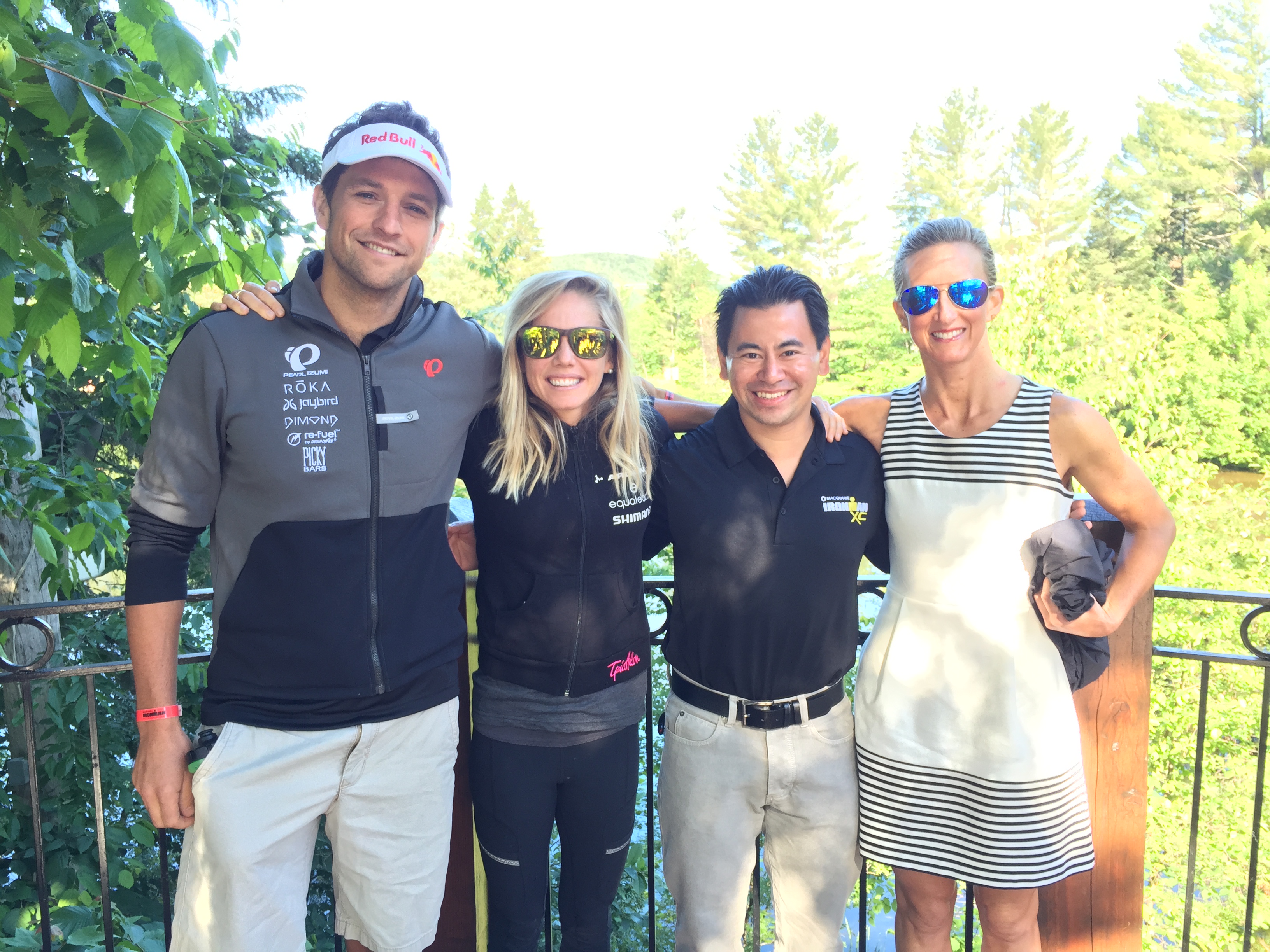
The race where I let go of fear and raced the way I used to — embracing the pain instead of guarding against it. A 1:23 PR over the same course a year earlier.
The swim. My archnemesis. My biggest fear. My reason to dislike triathlons — though I quite enjoy them otherwise. Last year I had the best swim of my life here despite an injury, coming out in 50:06. This year, having swum the Quassy Olympic in 36:09, I had some hope of getting near 40:00. Not brimming with confidence, but at least not cowering at swim start. Starting with my XC crew in Wave 2 — alongside the female pros, with Meredith Kessler high-fiving each of us — gave me a real boost.
It also made me too excited. Normally I walk into the water to keep my heart rate low. This time, as soon as the gun went off, I led my crew straight in. Bad idea. My heart rate was already up, and I had a few moments of panic between the first and fourth buoys where I had to stop. No trick — stroke focus, breathing, happy thoughts, peeing — could calm me down.
A paddleboarder saw me struggling and paced me through the first five or six buoys, which helped enormously; seeing scuba divers go in before my wave reassured me too. This is my fourth half-iron event and I've already finished an Ironman — the fear isn't logic, it's irrationality, and I still can't explain it. Once calm, I swam continuously to the end, slower than I'd hoped but a 2:22 PR.
Swim: 47:44 (last year: 50:06)
T1: 5:13
Bike
For the second triathlon in a row, my power meter wouldn't register — so I had no data and simply rode by effort. I put my head down and rode as hard as I could: when I didn't think I could maintain it, I rode harder; when I thought I was overcooking it, I kept it up. I told myself not to worry about the run, just ride the hell out of the course.
The course is hilly — Montée Ryan and the stair-stepper climbs on Chemin Duplessis (up to 8% grade). Jesse Thomas had told me at breakfast the key is to maintain power through the crest rather than backing off or coasting, so you carry momentum into the next climb. My descending was great — a guy rode up next to me and said, "Man, your bike really flies down the downhills!" If only I climbed as fast.
The plan worked, and I had the ride of my life. A teammate who flies on the bike didn't pass me until mile 43, which is when I knew I was having a great day (he rode a 2:20). The real reason: I actually raced this time. Instead of holding back, afraid of bonking or pain, I went for it — the way I used to race before getting injured. There's a meme: FEAR is False Evidence Appearing Real. For the past year I'd been afraid of pushing myself, afraid of re-injury. This was the first race in a long time I let that go and embraced the pain. It worked.
Bike: 2:57:53 (last year: 3:46:49)
T2: 1:29
Run
Off the bike my legs were jello — and then, for the first time in my life, I had to poop during a race. I skipped the first port-a-potties but had no choice by Chemin du Village. First mile, with the stop: 11:05. After that I felt much better, even if my legs wouldn't cooperate.
Once on the paved Le P'tit Train du Nord rail trail (flat for ~6 miles), I resolved to run each mile as hard as I could and just count down to the next aid station. My legs came around and I found a rhythm, trading encouragement with teammates heading back. I cramped badly around mile 8 — switched to flat Coke for sugar, walked a little, and gutted out the rest with "suck it up, buttercup."
Then a nasty surprise: they'd changed the course. Instead of an easy run down to the finish, this year turned left and went UP a steep hill for a lollipop around the top of the Village before dropping to the line. That's what I get for not reading the Athlete Guide. The final descent is steep and narrow and packed with exhausted triathletes, so my focus switched from running hard to not falling. I made it in one piece.
Run: 1:50:04 (last year: 2:29:15)
Overall: 5:51:23 (last year, same course: 7:14:34)
Quite a difference, huh? I had nothing left at the end — exactly how it should be.