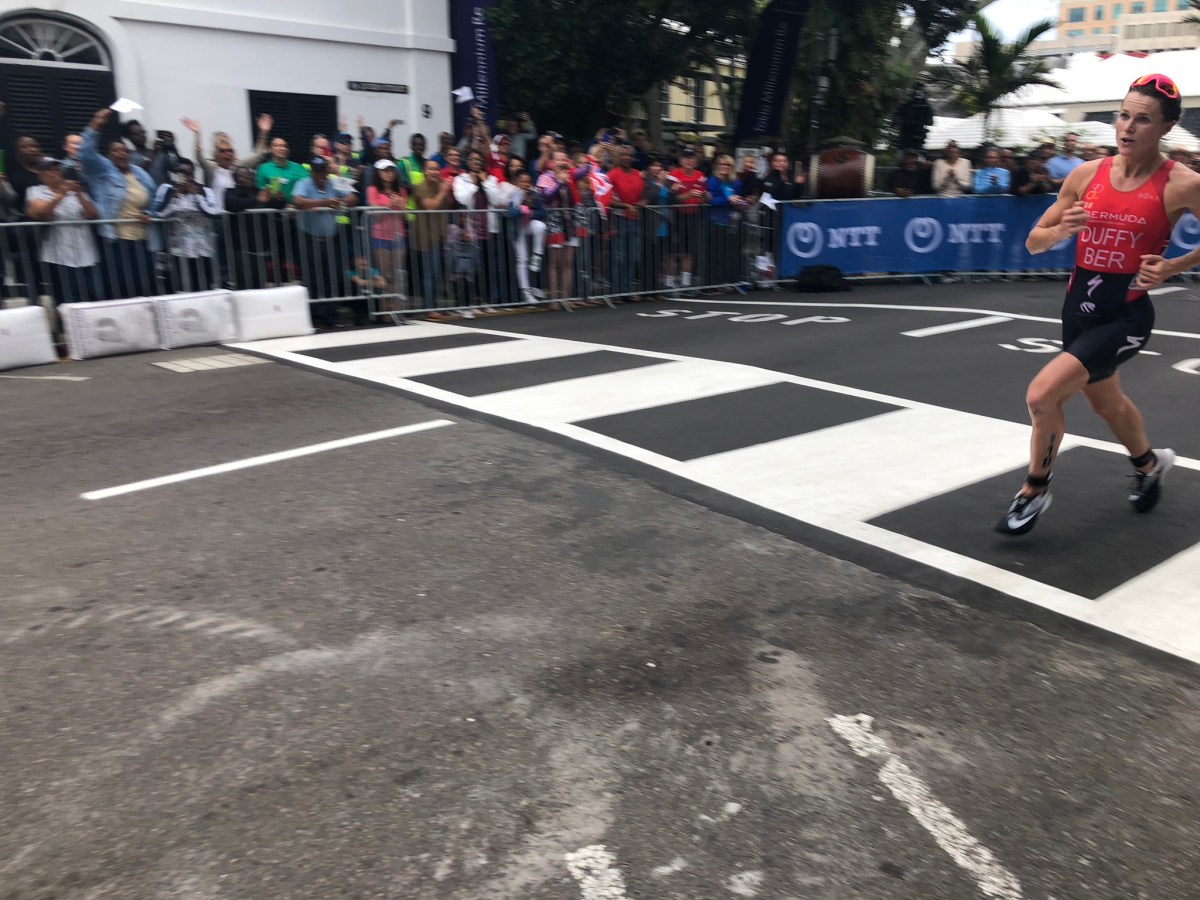
WTS Bermuda — the inaugural World Triathlon Series race on the island, my first race of the season, and my first-ever sprint tri. A race about rediscovering why I do this at all.
This race was a first of many, and of many a first. WTS Bermuda is the inaugural World Triathlon Series/ITU race to be held in Bermuda. It was also my first "race" of the season and my first of what will hopefully be many sprint tris.
I realize it's a bit weird for me to say that: I've finished five Olympic-distance triathlons, seven 70.3s and three 140.6s, but I've never done a sprint. But I digress…
Before the race, a few minutes on Bermuda itself, because it's such a wonderful place. I've now been four times, and I absolutely love it. It's a beautiful island and the people are incredibly friendly and welcoming — from the moment you set foot there, you feel at home. Despite being just 21 square miles, there's so much to see and do: the beaches of Elbow Beach and Horseshoe Bay, the Crystal Caves, the bustling city of Hamilton with Front Street, and historic St. George. My recommendation for first-timers? Talk to the cab drivers who pick you up from the airport. Most double as tour guides and are incredibly proud of their island. Best part? It's less than a two-hour flight from NYC.
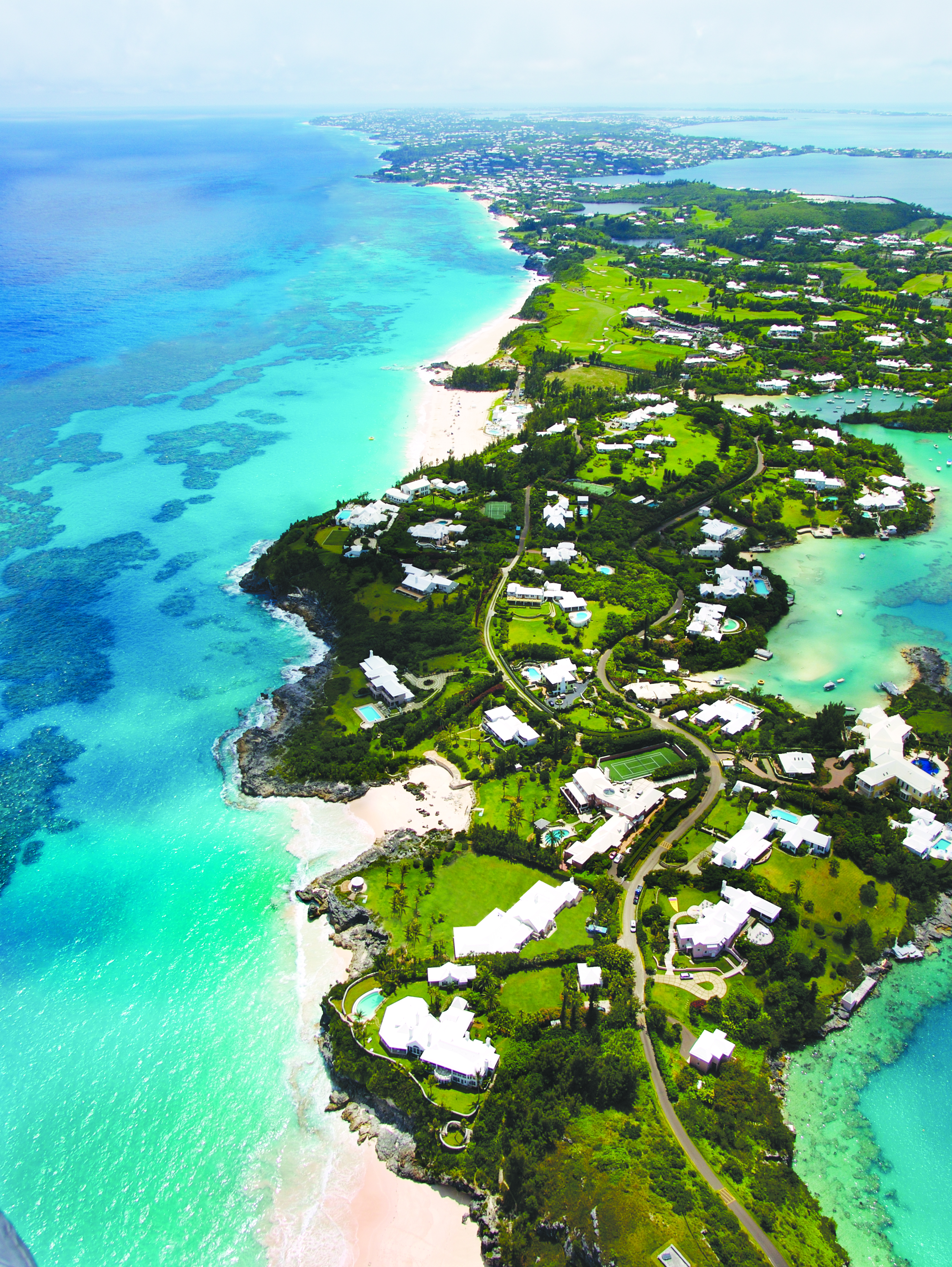 Aerial view of Bermuda
My first athletic experience in Bermuda was in 2013, at the Bermuda Triangle Challenge — a mile run Friday night, a 10K Saturday morning, and a full or half marathon Sunday. Great fun, and as I learned, Bermuda is incredibly hilly. So much so that after signing up for WTS Bermuda, I wondered which bike to bring: road or TT?
Luckily, this past January I was invited to a training camp/media activation hosted by the inestimable Flora Duffy — esteemed company including Kelly O'Mara, Nicola Busca, and Kevin Mackinnon. We had a couple of epic rides and runs (the Rail Trail is a great place to run) and swam in the National Training Center's 50m outdoor pool, where we ran — swam? — into Tyler Butterfield.
I was also taken around the course by the Race Organizer, Philip Schmidt, which let me see the whole thing first-hand, including the famous Corkscrew Hill. My takeaway: while Bermuda is hilly, the bike course really isn't. Two hills of note, a decently technical back half, but you only get out of aero two or three times. For the race, I'd recommend a TT bike.
A few equipment notes for anyone racing it: the race falls under a combination of ITU and BTA rules, which mandate a sleeveless kit (my tri suits are all sleeved — thanks to Beth McKenzie and Wyn Republic for coming through in a clutch). Bring a wetsuit (ours went wetsuit-legal by 0.1°C). Bring old flip-flops for the ~500m walk from T1 to swim start. Skip the disc — the crosswinds toward Dockyards can be wicked.
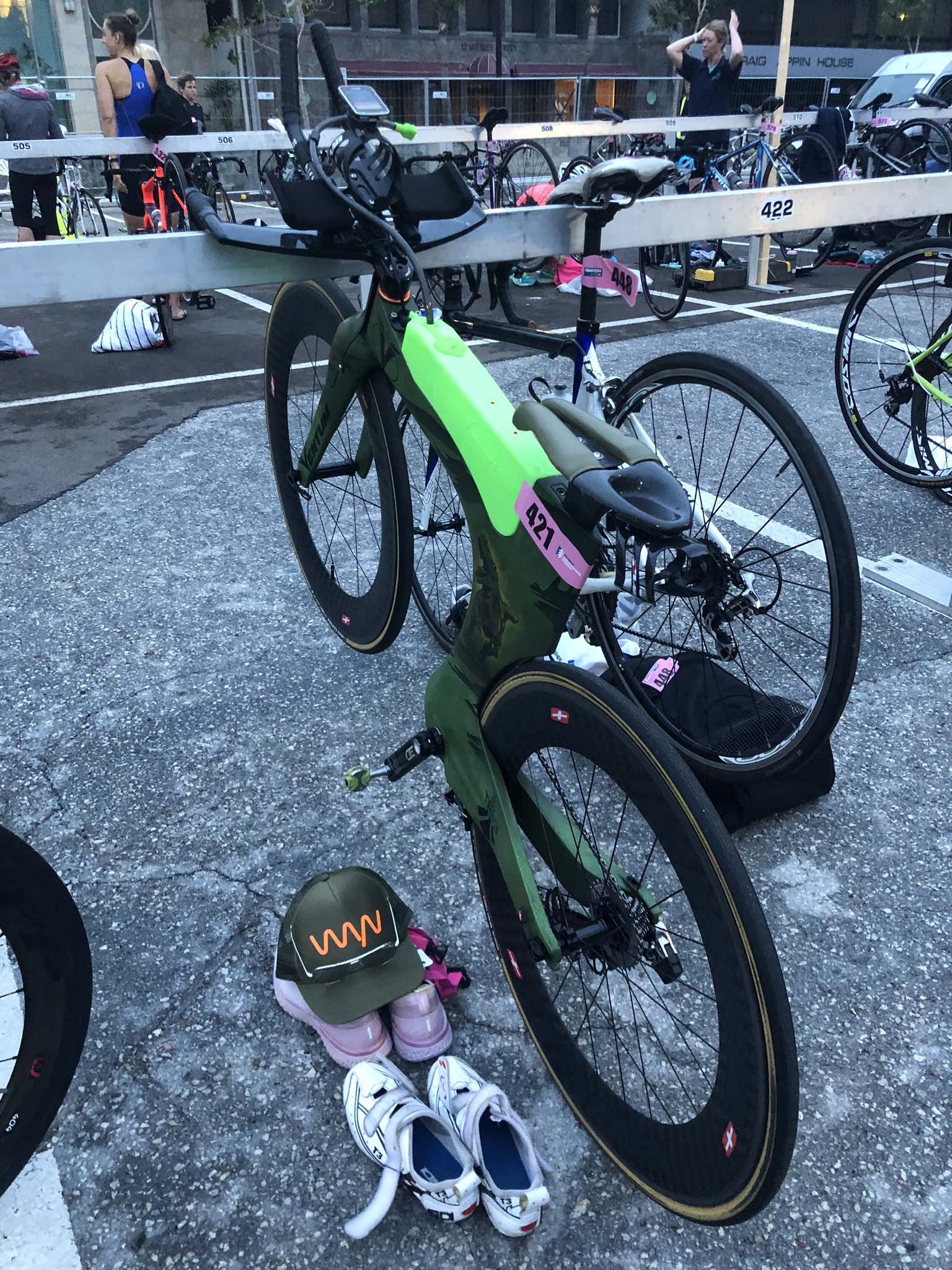 The T1 racks are rectangles, not the usual sawhorses — I had to hang my bike by the base bar.
Leading up to the race, I knew I wasn't properly trained for a sprint. I didn't have the speed work a sprint demands, and honestly I'd had a hard time re-motivating myself after the debacle of last year's season. I didn't start buckling down until early March, which gave me about two months to raise my fitness from a CTL of 42 to 81 on race day. I was also carrying real fatigue going in (-22 TSB the day before) — I didn't taper, and couldn't really justify one given how recently I'd started training.
I had one primary and one secondary goal: get out of the swim, and have fun. Last year I stopped having fun with triathlon, and I needed a big step back. Instead of focusing on performance and individual goals, I wanted to rediscover the joy I feel when I train and race. So I switched tri teams to train with a larger group, and I didn't register for any long-course races.
Now enough preamble — let's talk about the race.
The Swim
The swim is entirely within Hamilton Harbor. The sprint starts against the sea wall, goes south across the bay, turns west across four buoys, then north back toward the wall and the purpose-built swim-exit stairs.
The water was fairly choppy from the wind — not a sighting problem, but I got the occasional mouthful of seawater instead of air. What did give me trouble: I was kicked in the face about five minutes in, which dislodged my right contact lens. Something very similar happened at 70.3 Worlds, but I handled it much better this time. Instead of panicking and grabbing the nearest kayaker, I stayed calm, readjusted my goggles, and kept swimming.
Other than that, the swim went well. I had moments where my heart rate started to climb, but I handled them on my own — treading water for a few seconds, getting calm, continuing. I didn't freak out about the thin on-course support (I spotted maybe four kayakers). I had something I'd never had before: calmness. Normally I'm freaked out and entirely in my head before a swim. This time I was relaxed, despite far less swim volume than usual — 5,000–6,000y/week starting in March, versus 10,000–12,500y/week last year.
What helped most was a practice swim the day before. My good friend and XC teammate Isaac Keselman swam beside me and noticed my absurdly high stroke count — four or five strokes for every one of his. He had me slow down, count to three, and glide before the next stroke. My heart rate dropped immediately and I felt more relaxed. My old mindset was that if I'm not moving, I'm sinking; he showed me my hips and legs actually ride higher when I glide. And I wasn't appreciably slower, because I generated more power per pull when I wasn't fatiguing on every stroke. Life-changing — and it gave me something to focus on whenever my heart rate started to rise. Thank you, Isaac and Abby.
I came out of the water in 21:16 — about five minutes slower than I wanted, but calm and in a far better mental place than usual.
Swim: 21:16
T1
Long run out of the water and into T1 — mostly on ITU blue carpet, up Queen Street, which starts gently and really kicks at the end. About 400m to transition. I took off my wetsuit, grabbed my helmet, put on my bike shoes, grabbed my bike and left. Out of practice and could've been smoother — and I need to learn a flying mount.
T1: 3:27 (Overall: 24:43)
Bike
A two-loop course. The notable feature is Corkscrew Hill — short, but it kicks up immediately and the tight turn kills your momentum. I've ridden down it three times before, so I knew what to expect.
On my first loop I switched to the small ring approaching the circle but kept some chain tension mid-cassette. When I made the right and stood up to shift easier, I heard a loud clank, ground my gears, and dropped my chain (despite a chain catcher) — almost falling off the bike. I got the chain back on in seconds, but the gradient was too steep to remount. A spectator told me not to bother and just run it up. She was right.
Running up Corkscrew in bike shoes while pushing my bike destroyed my legs. I knew I was wrecking my run and the second loop, but I didn't care — nothing's more embarrassing than a fully-kitted triathlete with a fancy bike running up a hill while spectators cheer. On the second loop I was smarter, got into an easier gear early, and rode up it cleanly. The same spectator called out: "Yay! You made it!"
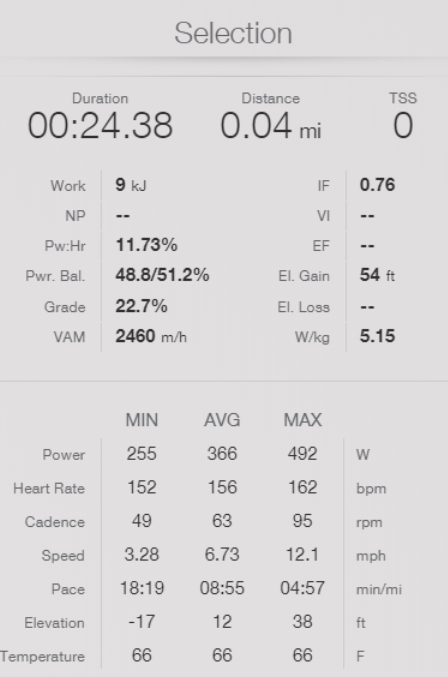 Second loop up Corkscrew — look at that average gradient (22%).
I rode the bike in 41:05, expecting closer to 35. My legs were loaded and my power showed it: I wanted ~200w and rode ~160 (zone 2). For comparison, at Challenge Roth I averaged 174w (NP 188) — for 112 miles. So I was disappointed, but unsurprised.
Bike: 41:05 (Overall: 1:05:49)
T2
Definitely out of practice. I missed my row, entered the correct one from the opposite side, racked on the wrong side, and had to duck under the rack to reach my shoes. Not my smoothest.
T2: 1:55 (Overall: 1:07:45)
Run
The run goes down Queen Street — top half a sharp downhill — where I noticed my right shoelace was untied. Rather than risk it, I stopped to tie it (taking advantage of the downhill to get back up to speed) and waved to a little girl cheering across the street. Then down Front Street, parallel to the bike course, out-and-back twice. I knew this stretch well from the Front Street Mile.
Nothing dramatic to report — and that was the point. It was fun to run Front Street twice with the crowds and see my friends out there. I ran a low-zone-3 effort for 24:48, about four minutes off goal, but I'd decided early that since I was well off my target time there was no point killing myself. I smiled the whole way. No repeat of my Ironman Arizona finish-chute disaster.
Run: 24:48
Overall: 1:32:33
Closing
Running down that finish chute, I was ecstatic. It's the shortest triathlon I've ever raced, and one of the most meaningful. Last year was so demoralizing that I wasn't sure I'd regain the happiness I feel when I race and train. Thanks to my friends and to the beautiful island of Bermuda, I have. I'm re-motivated to get back out there, keep racing, and keep getting better at the swim. Not there yet — but moving in the right direction.
Special thanks to Abby (the best sherpa I've ever had), Isaac and Maria, the Ventum family, Beth at Wyn Republic, Kris Gemmell, and the lovely people of Bermuda. Can't wait to be back.